How recommendations, flags, and results are surfaced. Clear. Contextual. Never ambiguous.

AI PRODUCTS & AGENTS — An Industry by Osiflow
There is too much noise. Not enough signal.
The AI space is full of products that are technically impressive and humanly illegible. Users open them, feel uncertain, and close them. The experience is where AI adoption fails. Not the model.
Start with a free audit
See work72 hrs • Actionable next steps
We go deep where stakes are high.
We have watched AI products fail not because the model was wrong but because the experience made people feel wrong for using it. Uncertain. Untrusting. Disengaged. The model shipped. The adoption did not. The interface is not a wrapper around the AI. It is the first thing a user decides to trust or walk away from.
Most agencies design for engagement. We design for systems where trust has to be earned at every screen.
We have watched AI products fail not because the model was wrong but because the experience made people feel wrong for using it. Uncertain. Untrusting. Disengaged. The model shipped. The adoption did not. The interface is not a wrapper around the AI. It is the first thing a user decides to trust or walk away from.
Most agencies design for engagement. We design for systems where trust has to be earned at every screen.
The Problem
Powerful AI. Invisible to the humans who are supposed to trust it.
Enterprise AI fails most often not because the model is wrong. It fails because the operator cannot understand what the model is doing. That is a design problem, not an engineering one.
01
Outputs that operators do not act on
Most healthcare dashboards are the result of years of additions. What was designed for one workflow now carries twelve. Staff spend cognitive energy navigating, not deciding.
02
No designed handoff b/w AI & human
When it takes weeks to train staff on a platform, the platform is the bottleneck. The right interface makes the correct action obvious. Without instruction, without hesitation.
03
Explainability that reads like a log file
Confidence scores and model weights are not explainability. They are engineering readouts. Users need a plain signal. What happened. What it means. What to do. In that order.
Crafted by humans, for humans, using AI agents combined with years of hands-on experience.
WHAT WE DESIGN
The experience layer that makes AI legible, safe, and worth using.
We do not design around the model. We design around the human reading it. Every screen answers the same question. Does this make the user feel capable or confused?
AI Output Design

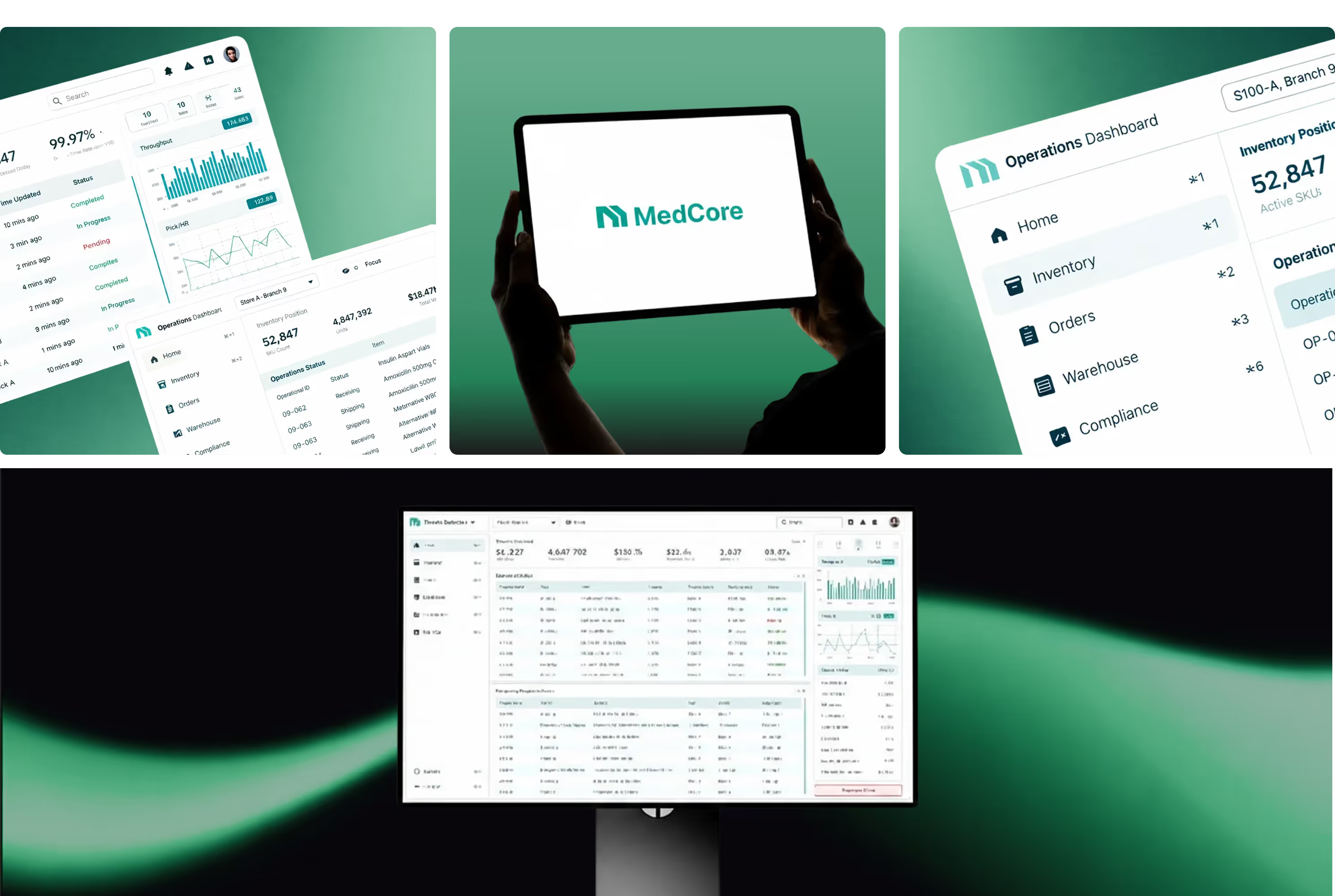
Osiflow HMI for AI Agents
Operator interfaces for agentic AI systems. Where the agent acts and the human stays in control. Built for trust from the first session.
Human-in-the-Loop Interfaces
Override flows and escalation moments. Designed so users know exactly when and how to intervene.

Explainability and Audit Surfaces
Plain-language reasoning, decision trails, and accountability records. For both operators and regulators.
Senior judgment. Every engagement, every time.
THE osiflow STANDARD
We design around the emotion of the user, not the logic of the model.
When a person opens an AI product, they feel something. Confidence or uncertainty. Control or confusion. We design for the former. Every time. Across every AI product type - SaaS, agentic, embedded, or enterprise platform.
Visionary.
We make AI feel safe without making it feel limited.
Crafted.
Interfaces that build trust between humans and systems.
Iconic.
A product presence that earns adoption before the first output.
TESTIMONIALS
Trusted by People & Brands Globally

enterprise wordpress vip
"Shreshth and the Osiflow team were proactive with updates, quick with iterations, and solid with documentation and research. If you value a structured process and clear communication, Osiflow is a dependable partner."

Aviral Mittal
Chief Marketing Officer

GLOBAL BANKING
"Shreshth's designs are always innovative and user-friendly. He is serious yet excited about every new project he gets to work on."

Priya Singh
Lead Experience Designer
for you
Related to Healthcare & MedTech
Let's Talk
Your AI is capable. Does the experience around it prove that?
Enterprise buyers and everyday users form their view of AI from the interface. Not the model card. Let us show you where better design changes adoption.
Prefer async communication?
response time <24 hours avg
Headquarters

New Delhi, India
11:11:11 PM
Write to us
business
hello@osiflow.com
career
careers@osiflow.com
Social


Osiflow
© 2026 oSIFLOW™. tRADEMAK FILED BRAND. All rights reserved.